A look at the Iran and Russia-linked hybrid attacks the U.K. spy chief says are flourishing
London — The head of Britain's top domestic spy agency MI5, Sir Ken McCallum, painted a dark picture Tuesday of the changing national security threats facing the U.K. and the world.
McCallum said that among state threats, "Russia remains aggressor number one," while intelligence analysts have also seen a "major shift" in "Iranian ambitions to come at harder targets."
But as the U.S. war with Iran nears the eight month mark, analysts have also seen the Iranian regime, "like Russia, attempting to expand their hybrid campaign," he said, leading to more than 50 arrests in the U.K. over the last year alone.
Many of these attacks were claimed by a group calling itself Harakat Ashab al-Yamin al-Islamiya (HAYI), or the Islamic Movement of the Companions of the Right, which U.K. authorities have sanctioned and said is tied directly to the elite Quds Force of Iran's Islamic Revolutionary Guard Corps, which Britain considers a terrorist organization.
A CBS News investigation in March found the group appeared to have links to Iran, and a member said it would "keep threatening U.S. and Israeli interests worldwide until we've avenged every child in Gaza, Iran, Lebanon, and the resistance nations … We urge people to stay away from Zionist and American interests and individuals to keep themselves safe."
Liège, Belgium: March 9. An explosive device detonated at a synagogue, causing no casualties. Attack claimed by HAYI.
Amsterdam, The Netherlands: March 14. A device detonated outside a Jewish school. Attack claimed by HAYI.
Antwerp, Belgium: March 24. A car set on fire in a Jewish quarter of the city. Attack claimed by HAYI.
Nijkerk, The Netherlands: April 4. A device detonated outside the premises of a group called Christians For Israel. Attack claimed by HAYI.
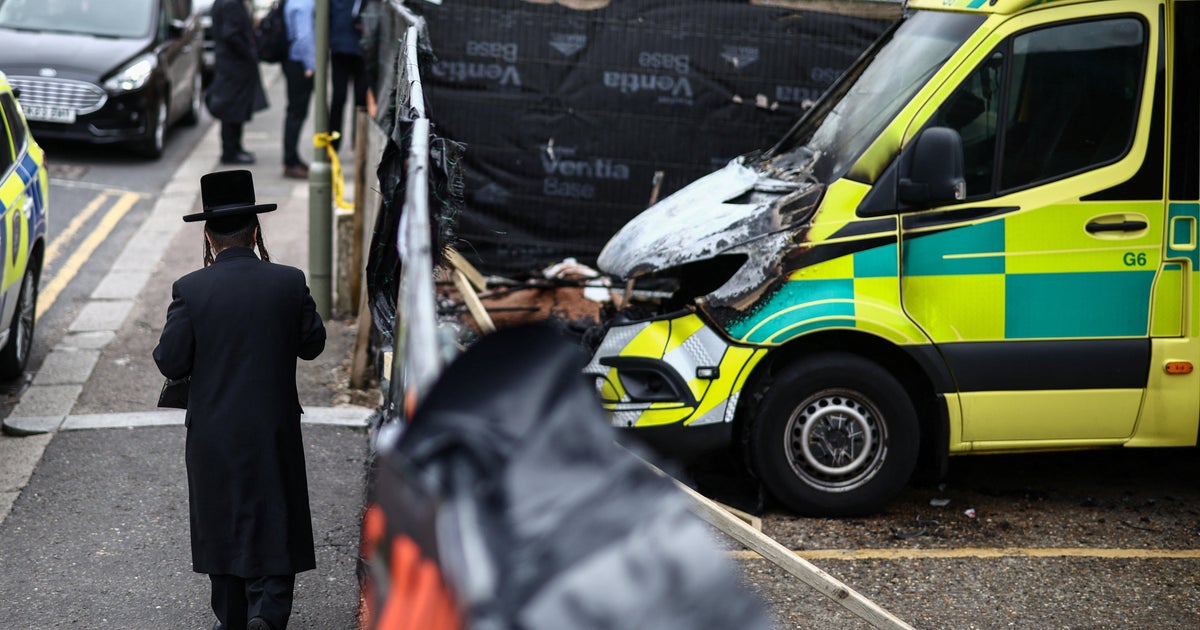
Park Royal, London: April 15. An attempted arson attack against Persian-language news outlet Iran International. Responsibility for the incident was never claimed. In March 2024, a journalist for the channel, Pouria Zeraati, was stabbed outside his home in London. According to The Guardian, counterterrorism police and security services in Britain believed the Iranian regime used criminal proxies to carry out the attack.
Harrow, London: April 18–19. A suspected arson attack at a synagogue in Harrow, then a bottle containing accelerant was thrown at the Kenton United Synagogue a day later. Attack claimed by HAYI.
RAF Fairford, England: Sept. 27. Suspected plot involving British base used by U.S. bombers to strike Iran. Gasoline was found in vehicles, but no viable explosives. British Prime Minister Andy Burnham said the incident was "almost certainly" directed by Iran.
Dive deeper
- London — The head of Britain's top domestic spy agency MI5, Sir Ken McCallum, painted a dark picture Tuesday of the changing national security threats facing the U.K. and the world.
- McCallum said that among state threats, "Russia remains aggressor number one," while intelligence analysts have also seen a "major shift" in "Iranian ambitions to come at harder targets."
- But as the U.S. war with Iran nears the eight month mark, analysts have also seen the Iranian regime, "like Russia, attempting to expand their hybrid campaign," he said, leading to more than 50 arrests in the U.K. over the last year alone.
- Many of these attacks were claimed by a group calling itself Harakat Ashab al-Yamin al-Islamiya (HAYI), or the Islamic Movement of the Companions of the Right, which U.K. authorities have sanctioned and said is tied directly to the elite Qu
- A CBS News investigation in March found the group appeared to have links to Iran, and a member said it would "keep threatening U.S. and Israeli interests worldwide until we've avenged every child in Gaza, Iran, Lebanon, and the resistance n