How AI Could Help Turn Carbon Dioxide Into Fuel
A computer-assisted map of reactions on copper may help researchers improve carbon dioxide conversion, though it does not show that the process is ready for use.
The short version
- AI combined with computer simulations helped researchers at the Indian Institute of Science identify 9,389 reactions on a copper catalyst involved in converting carbon dioxide into chemicals and fuels 1.
- The reaction map includes pathways conventional models had missed, which could give researchers a fuller picture of how carbon dioxide hydrogenation works 1.
- The study reported an unexpected way hydrogen may participate in the reactions, but the source does not show that this finding has produced a more effective catalyst 1.
- The work is a research tool, not proof that carbon dioxide can already be turned into fuel cheaply or at large scale 1.
How could AI help turn carbon dioxide into fuel?
AI can help researchers sort through a complicated set of possible chemical steps. In this study, scientists combined machine learning, a form of AI that learns patterns from data, with computer simulations to identify 9,389 reactions taking place on a copper catalyst as carbon dioxide is converted into fuels and chemicals 1.
The work focused on hydrogenation. That is a process in which carbon dioxide reacts with hydrogen, with a catalyst helping the reaction along. One possible product is methanol, a useful chemical that can also serve as a fuel 1.
What did the researchers find on the copper catalyst?
The researchers mapped many individual reactions on copper, rather than relying on a smaller set of steps in conventional models. The source says the mapping revealed pathways those models had missed and improved predictions of carbon dioxide conversion 1.
The researchers also found an unexpected way hydrogen can take part in the reactions. This challenges existing assumptions about how the process works, but the available source does not give enough detail to establish exactly how that finding changes catalyst design 1.
Why does mapping more reactions matter?
A catalyst's surface can host many chemical steps. Accounting for every possible step with quantum-mechanical calculations, which model how atoms and electrons behave, can require substantial computing effort. The study used machine learning alongside simulations to examine a large reaction network 1.
A more complete map could help researchers identify which steps matter and where a catalyst might be improved. That is a potential use of the findings, not evidence that a better-performing catalyst has already been made 1.
Does this mean carbon dioxide fuel is ready?
No. The reported result is a computational study of reactions on a copper catalyst. The source describes possible value for future catalyst development, but does not report a commercial process, a working fuel plant, or proof of low-cost production at scale 1.
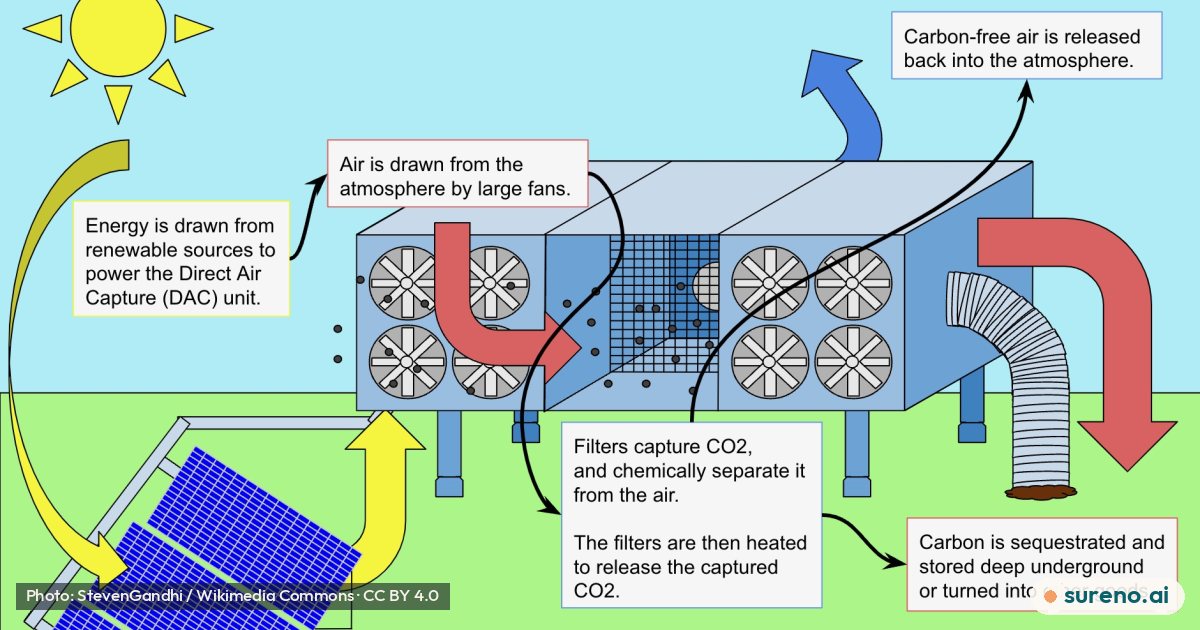
Turning carbon dioxide into a fuel also does not, by itself, establish that the overall process removes carbon from the atmosphere. The provided source on direct air capture explains that carbon dioxide removal depends on capturing carbon from ambient air and storing it safely for the long term; it does not assess whether this fuel-making process achieves that outcome 3.
What still needs to be tested?
The main open question is whether the newly mapped reactions can help produce catalysts that work better in real experiments. The available account does not provide measurements of fuel yield, energy use, cost, catalyst lifetime, or performance outside the simulated reaction network 1.
The study is described as published in Nature Communications, but the research details supplied here are limited to a summary. That makes it difficult to judge the methods or independently assess the reported predictions from these sources alone 1.
What we don't know yet
- Whether the mapped pathways lead to a catalyst that performs better in laboratory experiments.
- How much energy, hydrogen, and money a practical process would require.
- Whether the approach could work reliably at industrial scale.
- Whether producing fuel this way would reduce emissions overall; the supplied research summary does not establish this.
Share this explainer
New discoveries on every new tab
Sureno Browser puts explainers like this one on your start page every morning, in plain words.
Questions people ask
Can AI convert carbon dioxide into fuel?
AI does not itself convert carbon dioxide into fuel. In this study, machine learning helped researchers map reactions on a copper catalyst that could inform future work on carbon dioxide conversion 1.
What is carbon dioxide hydrogenation?
Hydrogenation is a process in which carbon dioxide reacts with hydrogen, assisted by a catalyst. It can form chemicals such as methanol 1.
What did the IISc researchers discover?
The researchers identified 9,389 reactions on a copper catalyst using machine learning and computer simulations. Their map included pathways conventional models had missed and an unexpected way hydrogen may participate 1.
Can carbon dioxide fuel reduce emissions?
The supplied account does not establish whether this approach reduces emissions overall. It reports a reaction-mapping study, not a full assessment of the energy, materials, or emissions involved in making fuel 1.
Is turning carbon dioxide into fuel the same as carbon removal?
Not necessarily. The provided description of direct air capture says carbon removal occurs when carbon dioxide is extracted from ambient air and then stored safely for the long term 3. The sources do not show that the fuel-making method described here achieves that.
Sources
- AI reveals a hidden chemical shortcut that could turn CO2 into fuel — ScienceDaily
- Direct air capture — Wikipedia
Free tools for this
They run in your browser. Nothing is uploaded and there is nothing to sign up for.
More to read
 ScienceWhy Humanlike AI Responses Don’t Prove ConsciousnessOct 14, 2026 · 4 min read0 views
 ScienceWhat groundwater, plankton and reef algae revealOct 14, 2026 · 5 min read0 views
 ScienceHow the Aharonov-Bohm Effect Can Halt a ParticleOct 13, 2026 · 3 min read0 views
 ScienceHow DNA Recording Could Reveal How Cells Build a BodyOct 13, 2026 · 3 min read0 views
 Food & CookingChar Siu Explained: Cantonese Barbecued Pork at HomeOct 3, 2026 · 3 min read2 views
 ScienceWhat research says about air, green space and healthOct 13, 2026 · 4 min read0 views
 ScienceThree materials studies probe battery and magnet limitsOct 12, 2026 · 5 min read0 views
 ScienceCould Neanderthals Have Used Birch Tar on Wounds?Oct 11, 2026 · 3 min read0 views
 ScienceWhy Nikon Disqualified an AI-Generated Contest ImageOct 10, 2026 · 3 min read0 views
 Safety & RecallsWhy Faslane Naval Base Is Adding Ballistic SheltersOct 14, 2026 · 3 min read0 views