Ukraine is littered with landmines on a scale last seen in Vietnam. How can they be removed?
Faced with deadlier threats, demining groups are coming up with new ways of working using drones and AI
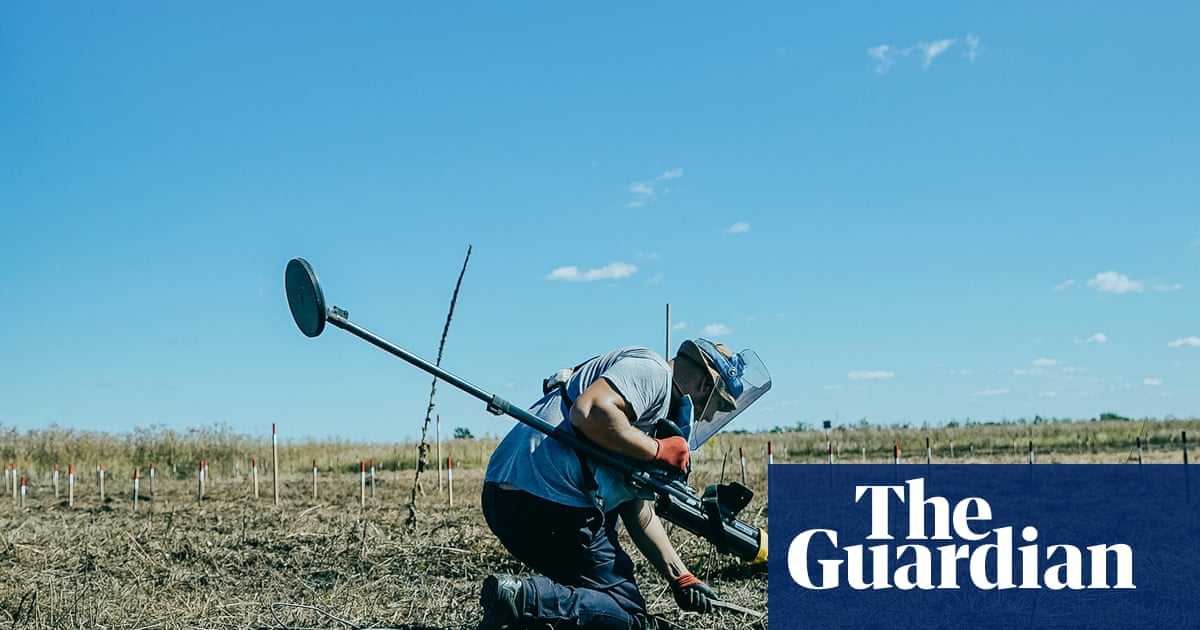
Crouched over on her hands and knees in a field of weeds, Olena Kabanova is digging into the ground. With a shovel and a steady hand, the 58-year-old digs out a neat square around the spot where a mine detector has sensed a suspicious object.
Landmines are a scourge of conflict zones. Littered across contested territory, they leave land unusable for years after a war has ended. Removing them is an expensive and dangerous job. And the use of long-range drones in Ukraine, which is often described as the most mine-contaminated country in the world, is increasing the scale of the problem.
“What we’re now seeing is the massive increase in the use of drone-delivered munitions,” says Paul Heslop, the programme manager for mine action at the United Nations Development Programme in Ukraine. “What already was a very high-intensity battle area is now potentially, through the use of drones on both sides, becoming a much wider area of contamination and a scale that we haven’t seen since the Americans were dropping cluster munitions on the Ho Chi Minh trail.”
The task of clearing landmines from Ukraine is replete with challenges. Drone and missile attacks make working outdoors unsafe; humanitarian workers are sometimes directly targeted. And newer, deadlier threats are also appearing. They include the POM-3, a small cylindrical mine used by Russian forces that could be mistaken for an abandoned vacuum flask. It is detonated by the vibrations of approaching footsteps.
But the technological innovation that is emerging from the conflict is also helping deminers to come up with new ways of working, which they hope are quicker and safer than the traditional hands-and-knees approach. The advances are being supported by the $1.5bn funding that has poured into Ukraine’s demining sector since the start of the full-scale invasion.
The tank is operated by a human using a remote controller who stands at a safe distance away. The operator manoeuvres the tank into place and then, with a loud mechanical whirring and plumes of dirt billowing skywards, the DMR-7 uses the force of compressed air to blast away a small patch of soil. It is a bulky, expensive alternative to a shovel, but it’s one that deminers hope can make one of the most dangerous parts of the demining process quicker and safer.
The DMR-7 is just one of a host of new pieces of kit that the Halo Trust is experimenting with in Ukraine. Other technologies include AI-powered image analysis, ground-penetrating radar and devices that can detect explosive material, not just metal.
But war has also led to innovations in anti-drone technology. Drone jamming systems, used by both Russian and Ukrainian forces, can interfere with humanitarian work. Halo has lost several drones to jamming and spoofing attacks.
In a field adjacent to one that Kabanova is working in, staff from the state emergency services are also clearing mines. Under the glare of the late summer sun, Mykyta Shulzhenko, the head of the mechanised demining unit, says his colleagues have started using drones for surveillance. But they are not yet able to use AI to analyse the drone-captured imagery. “I really hope this kind of technology will be implemented soon in our work,” he says.
The Halo Trust alone spent nearly £50m in Ukraine in the year to 31 March 2025, dwarfing the state’s annual budget of £28.6m for a programme to clear agricultural land of mines and unexploded ordnance. And there are dozens of other demining organisations with overlapping responsibilities and approaches. Responsibility for the sector is split across multiple government agencies. Attempts to reform the country’s mine action law to bring it in line with international standards have faltered.
“When we’re talking about a new law, it will mean that some government bodies will lose responsibility, and, they think, power,” Bezkaravainyi says.
Dive deeper
- Faced with deadlier threats, demining groups are coming up with new ways of working using drones and AI
- Crouched over on her hands and knees in a field of weeds, Olena Kabanova is digging into the ground. With a shovel and a steady hand, the 58-year-old digs out a neat square around the spot where a mine detector has sensed a suspicious objec
- Landmines are a scourge of conflict zones. Littered across contested territory, they leave land unusable for years after a war has ended. Removing them is an expensive and dangerous job. And the use of long-range drones in Ukraine, which is
- “What we’re now seeing is the massive increase in the use of drone-delivered munitions,” says Paul Heslop, the programme manager for mine action at the United Nations Development Programme in Ukraine. “What already was a very high-intensity
- The task of clearing landmines from Ukraine is replete with challenges. Drone and missile attacks make working outdoors unsafe; humanitarian workers are sometimes directly targeted. And newer, deadlier threats are also appearing. They inclu