These workers help train robots who could one day steal their jobs
Podcasts & Shows Expand/collapse submenu for Podcasts & Shows Daily Morning Edition
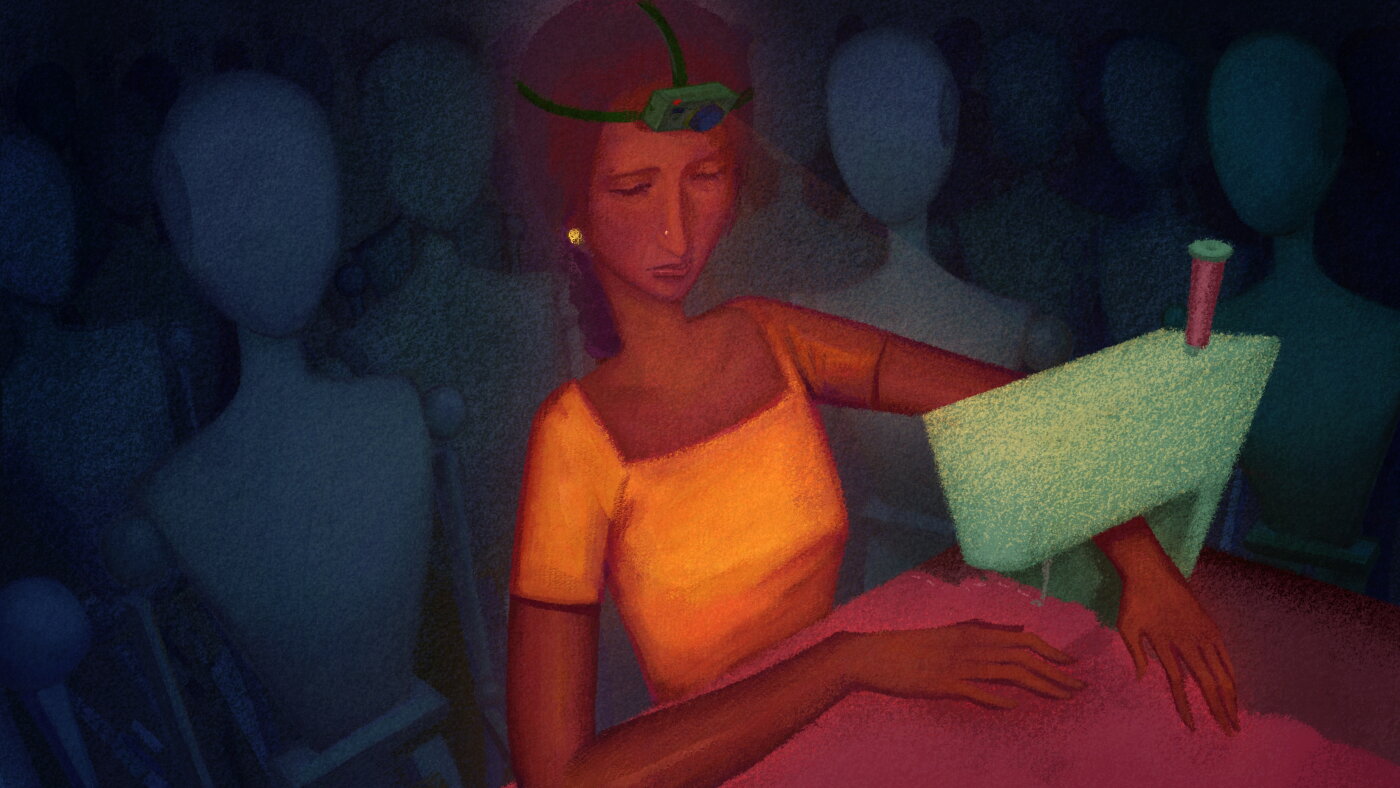
KARUR, India — Three men stride across a cavernous textile factory floor of Texworth in the southern Indian city of Karur, handing GoPros and smart glasses to workers, including 40-year-old Shoba Kirubakaran. She's packing yellow aprons decorated with chickens into plastic wrapping for the brand Designs By Danica. It's the third time Kirubakaran says she's been told to don a GoPro.
It's recording her every hand gesture, to train AI robots to take over this job — a fact that she says the company did not share with her. NPR informed her when they interviewed her on a recent day. "Nobody told me anything about it," she says.
Kirubakaran has worked in the factory for 10 years, 6 days a week, from around 9 a.m. to 6 p.m. She makes $90 a month. With that money, she's helped her husband, a rickshaw driver, raise their two sons. And she adds, "I only know how to do this job."
Scenes like these shook the Indian public in April after a video went viral showing rows of textile factory workers wearing these headsets. "This is not a scene from a science fiction film," warned one news anchor from outlet News9Live. "That is happening right now on factory floors across India." Another outlet, AsiaNet News warned: "Indian workers are training AI robots to take their jobs."
India is emerging as one key place to record this kind of footage because of its large population, relatively low wages and relative openness to new tech. And developers need millions of hours of this footage, what the industry calls egocentric data — data gathered from the perspective of a human with a camera to train AI robots.
"That can be obtained only by emulating or collecting data from real human beings that does the job," says Prathosh A.P., a professor at the Indian Institute of Science in Bengaluru. Like many other Indians, he uses initials to refer to his family name. "Think of today's AIs as brains without a body," he says. "Now you have to give them all motor skills ... to do all kinds of intricate motions that we do using a physical body."
Some workers are signing up because they're paid by the hour for the data. But it appears many others, like Kirubakaran, are simply made to record herself working without any explanation. "Call it what it is, which is exploitation of labor," says Astha Kapoor, co-founder of the Aapti Institute, which studies the impact of technology on people.
What will the impact be for India's workforce — the world's second largest, with 600 million people working or seeking work? "Training workers, retraining workers, absorbing them into new occupations," says Amit Basole, economics professor at Azim Premji University. "Do we have the policy agility to do that? I doubt it."
But that vision of a future full of factory and domestic robots isn't exactly around the corner, say some experts. AI robots are unlikely to be deployed at scale in India — in the near future at least — because they cost a lot of money and consume a lot of power, which is both unreliable and costly across parts of India. "We may be able to make the robots, but they're bloody expensive to run, right?" says Kapoor of the Aapti Institute. "Humans are cheaper to run than robots."
That power crisis is evident even in Karur, where an Indian tech company, Objectways, gathers egocentric data to sell onto AI developers. Massive generators loudly rumble to ensure seamless electricity in the buildings it powers. The company appears to be one of the town's biggest white collar employers, occupying at least four building blocks in the town.
The CEO, Ravi Shankar, is a Karur native who migrated to Arizona decades ago. He's in perhaps unlikely agreement with Kapoor about the deployment of AI robots in India. "I think it will be more expensive," he says of AI robots, in comparison to human labor. "I don't think it's going to be cheaper."
Dive deeper
- Podcasts & Shows Expand/collapse submenu for Podcasts & Shows Daily Morning Edition
- KARUR, India — Three men stride across a cavernous textile factory floor of Texworth in the southern Indian city of Karur, handing GoPros and smart glasses to workers, including 40-year-old Shoba Kirubakaran. She's packing yellow aprons dec
- It's recording her every hand gesture, to train AI robots to take over this job — a fact that she says the company did not share with her. NPR informed her when they interviewed her on a recent day. "Nobody told me anything about it," she s
- Kirubakaran has worked in the factory for 10 years, 6 days a week, from around 9 a.m. to 6 p.m. She makes $90 a month. With that money, she's helped her husband, a rickshaw driver, raise their two sons. And she adds, "I only know how to do
- Scenes like these shook the Indian public in April after a video went viral showing rows of textile factory workers wearing these headsets. "This is not a scene from a science fiction film," warned one news anchor from outlet News9Live. "Th