Aboard an icebreaker, a writer got a closer look at the Arctic's 'Sea Change'
Podcasts & Shows Expand/collapse submenu for Podcasts & Shows Daily Morning Edition
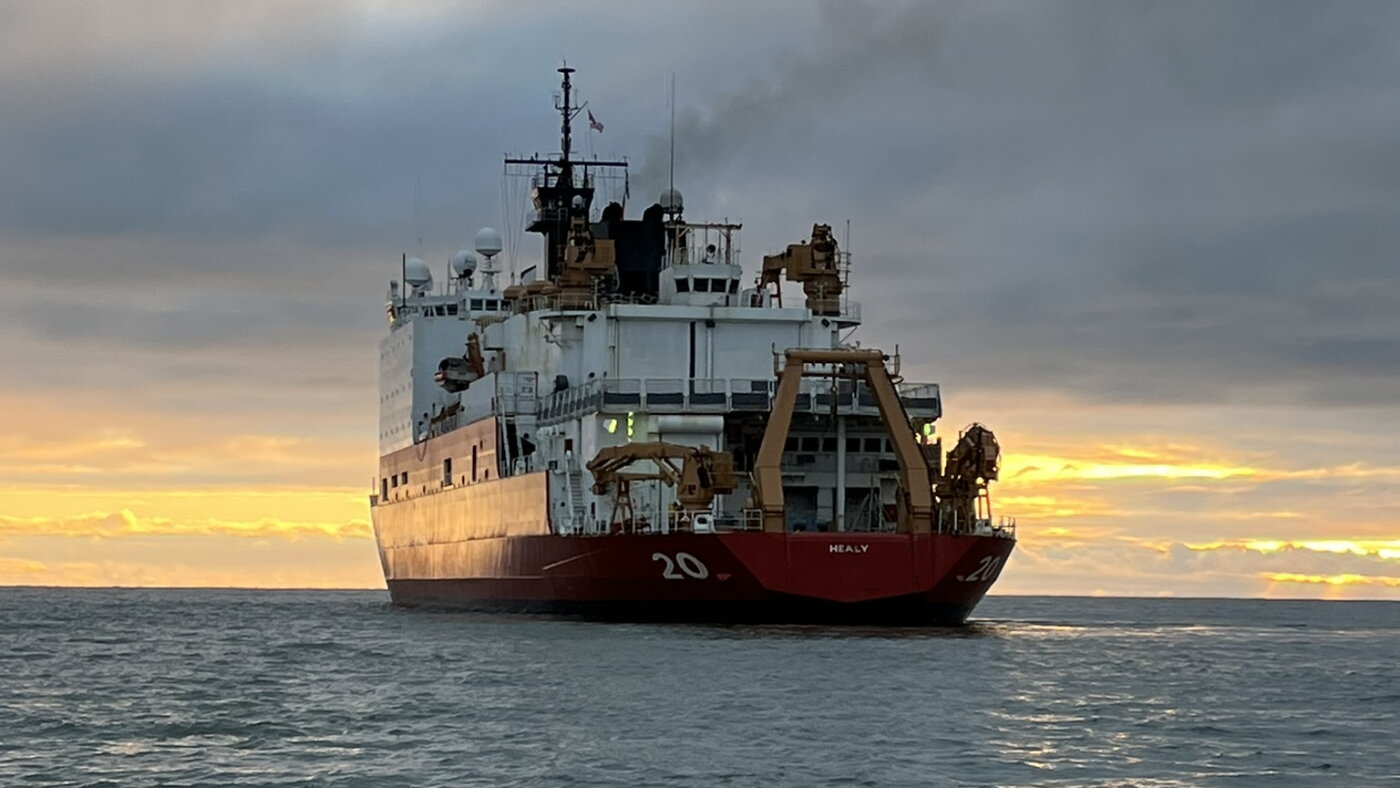
Rana Foroohar reports from the USS Healy (pictured above) in Sea Change. Crown hide caption
As polar ice melts in the Arctic, shipping lanes are opening up, making the region a new zone of superpower competition. Writer Rana Foroohar got an up-close look aboard the USS Healy, a Coast Guard icebreaker. She says that traversing the North Pole by ship — once a "largely conceptual" route — is now becoming a "real possibility" for two or three weeks a year.
"If you are taking one of these Arctic routes, you can save as much as 40% of the time it would take you to go from the Atlantic to the Pacific, and depending on the price of oil, that's a heck of a lot of money," she says. "China and Russia together are clearly trying to make the top of the world an area over which they have the most interest."
In her new book, Sea Change: America's New Great Game in the Arctic Circle, Foroohar makes the case that the "High North" may become as critical to world shipping as the Suez or Panama canals. But she also notes that beneath the Arctic waters are large deposits of oil, natural gas and rare earth minerals, as well as underwater cables, which carry a large part of the world's intercontinental information flow.
"Undersea cables have become a real touchstone in wars and conflicts around the world," she says. "So you are seeing a race to lay down new cable, and who can get there fastest, and then who can potentially commercialize and even militarize areas where those cables have been laid."
Orange rivers and melting glaciers: federal report shows rapid change in the Arctic
Foroohar describes the Arctic Circle as one of the few areas of the globe where countries and companies can still "hunt" for territory and "duke it out potentially with rivals." And she predicts more conflict in the coming decades as the region continues to warm.
"There is going to be more commerce done through this area. There is gonna be greater military interest in the area, and all of that matters because it really is in America's backyard," she says. "I just think that everything in the High North is going to be higher priority for America in the future."
China and Russia together are clearly trying to make the top of the world an area over which they have the most interest. And that's very interesting because it starts to dovetail with something that's happening in U.S. policy, which is more of a sense of we need to protect what's close to home. And so if you look at things that way, then you have the U.S. and China coming into much closer geographic conflict. Whether or not it would ever be a hot conflict, I hope not, but certainly competition in that area.
For the first time, there is a scheduled cargo shipping route through the Arctic
There's some debate over that. There is something called the United Nations Convention on the Law of the Sea, which governs maritime activities, including those in the Arctic. It has ... rules about where you can mine, how you can mine, who gets what. But the U.S. never signed on to that convention. Various presidents from Clinton to Bush [to] Obama did support it, but key Republican senators opposed it, basically on ideological grounds, the notion that no international body should have sovereign right over what the U.S. does. ... And so it makes it much more of a free-for-all as to who gets w
Dive deeper
- Podcasts & Shows Expand/collapse submenu for Podcasts & Shows Daily Morning Edition
- Rana Foroohar reports from the USS Healy (pictured above) in Sea Change. Crown hide caption
- As polar ice melts in the Arctic, shipping lanes are opening up, making the region a new zone of superpower competition. Writer Rana Foroohar got an up-close look aboard the USS Healy, a Coast Guard icebreaker. She says that traversing the
- "If you are taking one of these Arctic routes, you can save as much as 40% of the time it would take you to go from the Atlantic to the Pacific, and depending on the price of oil, that's a heck of a lot of money," she says. "China and Russi
- In her new book, Sea Change: America's New Great Game in the Arctic Circle, Foroohar makes the case that the "High North" may become as critical to world shipping as the Suez or Panama canals. But she also notes that beneath the Arctic wate