Spawning coral release quintillions of eggs each year: new research
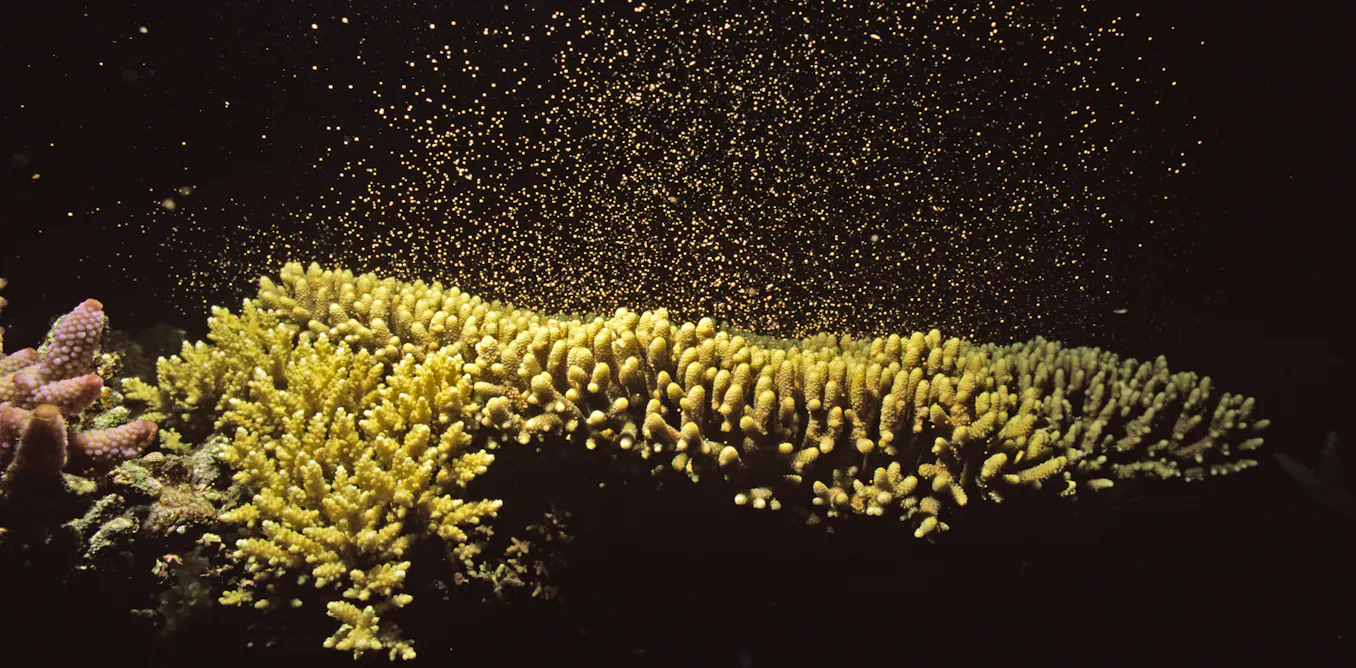
Most kinds of coral spawn once a year. In an enormous multi-day event synchronised to specific phases of the moon, they release vast slicks of eggs and sperm into the ocean to be mixed together by the drifting currents.
Imagine hundreds of thousands of Olympic swimming pools filled with tiny pinkish spheres, all dumped into the sea at once.
In new research published in Ecology and Evolution, my colleague and I have for the first time estimated just how many eggs are involved in one of these spawnings, and it’s a mind-boggling number.
According to our calculations, in a single spawning event, corals across the Indo-Pacific region release around 3.5 quintillion eggs (that’s 3,500,000,000,000,000,000 if you write out all the zeroes).
This isn’t a just a curious piece of trivia, either: it’s basic information we need to help preserve Earth’s coral species for the future.
Counting Earth’s ecological assets reveals how our planet functions. Knowing the total number of ants living in the ground (around 20 quadrillion) allows scientists to estimate how much carbon they can remove, for example.
Scientists have mapped half a trillion adult coral colonies, as well as tracking global fish egg production. These numbers tell us about the function and health of ecosystems.
Counting nature also tells us about its power to regenerate. Ocean life, and coral reefs in particular, are bearing the brunt of global warming. Since 1950, roughly 50% of global coral reef cover has disappeared.
This is why we want to know about coral’s capacity to reproduce and regenerate.
Our new study provides the first estimate of coral reproductive potential across the Indo-Pacific region, which is a hotspot for marine biodiversity.
Our estimate of 3.5 quintillion eggs released in a spawning establishes an essential baseline of what these reefs produce at peak capacity.
Measuring across hundreds of coral species, we found most eggs came from a few key groups. Branching Acropora, Porites (bommies or massive boulder corals), and Montipora accounted for around half the total egg supply.
Dive deeper
- Most kinds of coral spawn once a year. In an enormous multi-day event synchronised to specific phases of the moon, they release vast slicks of eggs and sperm into the ocean to be mixed together by the drifting currents.
- Imagine hundreds of thousands of Olympic swimming pools filled with tiny pinkish spheres, all dumped into the sea at once.
- In new research published in Ecology and Evolution, my colleague and I have for the first time estimated just how many eggs are involved in one of these spawnings, and it’s a mind-boggling number.
- According to our calculations, in a single spawning event, corals across the Indo-Pacific region release around 3.5 quintillion eggs (that’s 3,500,000,000,000,000,000 if you write out all the zeroes).
- This isn’t a just a curious piece of trivia, either: it’s basic information we need to help preserve Earth’s coral species for the future.