Shock, anger and a crackdown: why a contentious electoral revision has sparked outrage
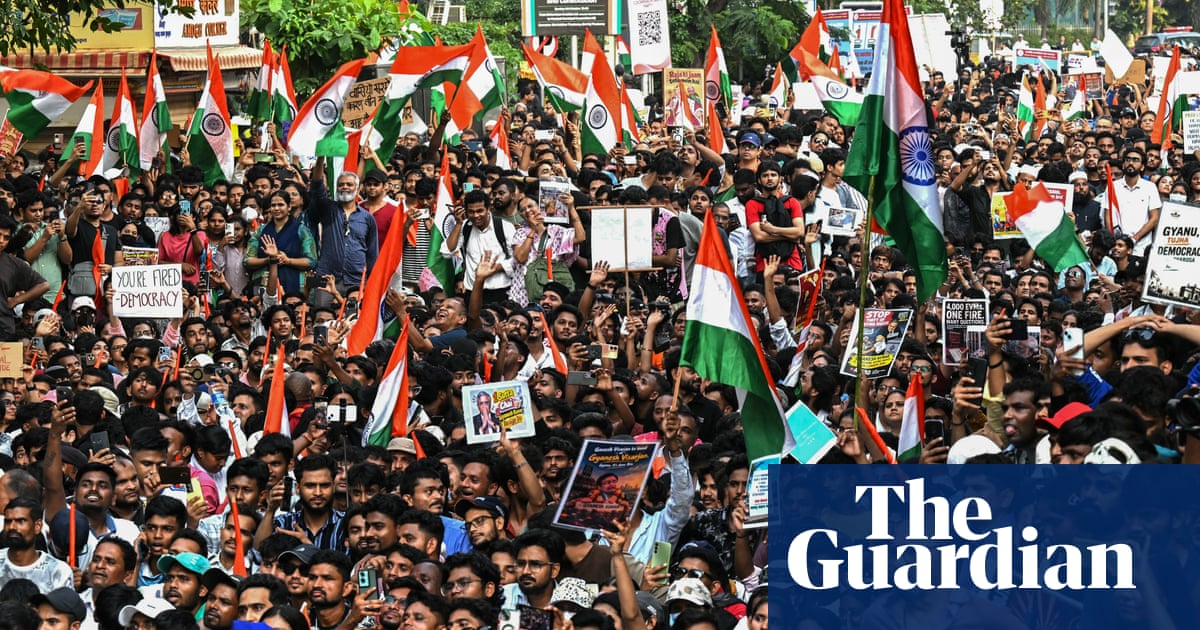
Marches in Delhi against changes to voting registration led to dragnets, internet blackouts – and questions about India’s electoral independence. Plus, the cinematographer capturing the beauty of the mundane
Months of simmering public anger have given rise to a season of discontent in India. In its latest iteration, the demand is for the removal of chief election commissioner Gyanesh Kumar and the scrapping of a controversial electoral rolls revision that has struck 130 million people off the register. Protests have erupted every day over the past week, prompting a violent crackdown on dissenters in the capital.
The founders of the Cockroach party were removed from an Air India flight shortly after it landed at Delhi airport on Saturday. Opposition leaders were held for more than eight hours in various police stations. Video footage showed students and activists being manhandled, beaten and dragged off the streets while some journalists were also swept up in the detentions. A supreme court lawyer assisting those detained was carried away by police, his shirt torn in the process. The crackdown extended to Mumbai, where Tushar Gandhi, the great-grandson of Mahatma Gandhi, was whisked away by the police
The crackdown was preceded by similarly aggressive police action against Congress party’s protests, led by Rahul Gandhi. Dramatic images of police personnel detaining Gandhi and his sister, Priyanka, amid scenes of chaos flashed across screens nationwide.
While suppression of protests is not new, what stands out this time is the scale of the crackdown in the capital. Government clampdowns in Indian-administered Kashmir have been far more severe, particularly in 2019, when sweeping restrictions were imposed after the revocation of Article 370.
The ferocity of the state response reflects the high political stakes for Prime Minister Narendra Modi’s government, which faces mounting resistance over the Special Intensive Revision (SIR) and questions about the credibility of the electoral process.
Former election commissioner Ashok Lavasa told me that the SIR process is unprecedented and unfair, marking a departure from the Commission’s traditional emphasis on inclusion. “For more than seven decades the ECI took it upon itself, as a duty, to enrol everyone who was eligible to vote. And that was one of the basic differences between how Indian democracy works and how other democracies function, where you need to apply to get enrolled,” he said. Voters accustomed to a “friendly procedure” now face a hostile system, which he said “is not good for democracy” in the long run.
As to what comes next, he envisions potential for three strands to find common ground: the opposition parties, organised civil society groups, and ordinary citizens. For a government that has shown no sign of budging yet, he said, the calculus will get harder. “The longer they delay, the higher the stakes.”
Human rights | South African jurist and former international criminal court judge, Navi Pillay, who is of Indian Tamil heritage, has won the 2026 Nobel Peace Prize. In a first-person account published in 2023, she wrote about her grandparents, who came from India and worked on a sugarcane farm in South Africa for five years before being allowed to buy land.
Climate| Citing a significant rainfall deficit linked to the El Niño weather phenomenon, the Maharashtra government last week announced water cuts of at least 10% across urban areas starting 16 October. The state government had previously declared drought conditions in 74% of the sub-districts.
With Delhi in the news for all the wrong reasons, I turned to Mayank Austen Soofi, who writes a daily Delhi column for Hindustan Times, to share a spot he returns to for a moment of reprieve. “Whenever I can, I spend a solitary afternoon at the tiny Sufi shrine of Hazrat Sarmad Shaheed, beside the Jama Masjid mosque. The bazaar outside the shrine is the Walled City’s noisiest quarter, yet inside one can sit in silence beneath the neem tree growing beside Sarmad’s grave. An Armenian Jew from Iran, Sarmad fell in love with a Hindu boy in Sindh, eventually became a naked fakir and settled in Mugh
For Mumbai-based cinematographer, Arbab Kamal Khan, the fleeting, unguarded moments of everyday life offer the most honest form of documentation. His Instagram account is an extension of this cinematic vision, capturing the languor of slow days, the beauty of the mundane and the quiet air of romance.
Dive deeper
- Marches in Delhi against changes to voting registration led to dragnets, internet blackouts – and questions about India’s electoral independence. Plus, the cinematographer capturing the beauty of the mundane
- Months of simmering public anger have given rise to a season of discontent in India. In its latest iteration, the demand is for the removal of chief election commissioner Gyanesh Kumar and the scrapping of a controversial electoral rolls re
- The founders of the Cockroach party were removed from an Air India flight shortly after it landed at Delhi airport on Saturday. Opposition leaders were held for more than eight hours in various police stations. Video footage showed students
- The crackdown was preceded by similarly aggressive police action against Congress party’s protests, led by Rahul Gandhi. Dramatic images of police personnel detaining Gandhi and his sister, Priyanka, amid scenes of chaos flashed across scre
- While suppression of protests is not new, what stands out this time is the scale of the crackdown in the capital. Government clampdowns in Indian-administered Kashmir have been far more severe, particularly in 2019, when sweeping restrictio