Nord Stream: Trial of Ukrainian attack suspect begins in Germany
A Ukrainian citizen faces court in Hamburg, accused of attacking the Nord Stream gas pipelines in 2022. It raises questions about Kyiv's possible role in the explosions. German support for Ukraine is also under scrutiny.
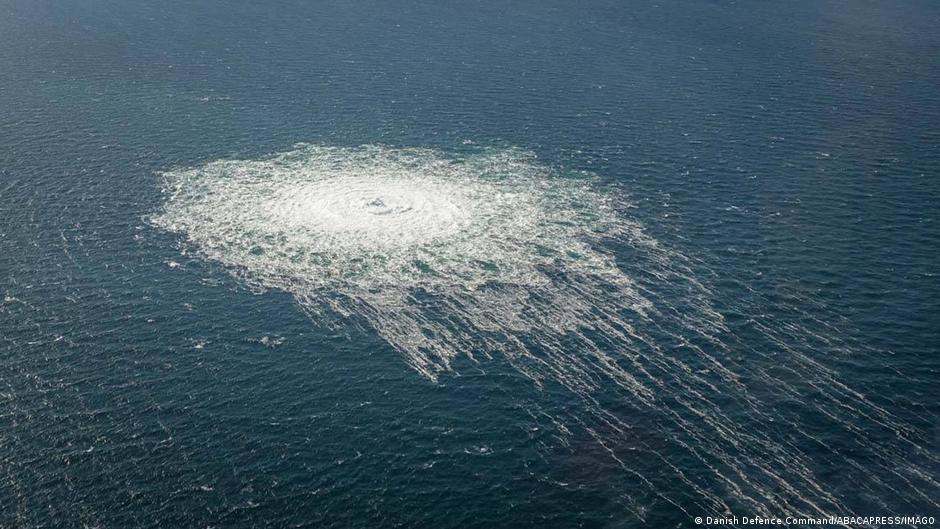
The aerial photos made headlines worldwide: On September 26, 2022, massive quantities of methane gas bubbled on the surface of the Baltic Sea near the island of Bornholm. Unknown people had blown up three of the four sections of the Nord Stream 1 and 2 gas pipelines from Russia to Germany.
The attack, which occurred seven months after Moscow launched its full-scale invasion of Ukraine, meant the end of a mega energy project between Germany and Russia in which both sides had invested billions, and which secured affordable Russian gas for Germany. However, the flow of gas via Nord Stream 1 had been restricted or stopped several times by Russia since the Ukraine war began; Nord Stream 2 was not yet operational.
From October 14, Ukrainian citizen Serhii K. is facing trial before a court in the northern German city of Hamburg. He was arrested in Italy in August 2025 on a European arrest warrant and later extradited to Germany. This week he must answer for the attacks before the Hanseatic Higher Regional Court. He is accused of being an accomplice to a war crime by attacking civil energy infrastructure, disruption of public services, causing an explosion and destroying structures.
Ukrainian President Volodymyr Zelenskyy has repeatedly said that Ukraine was not involved in the 2022 attack on the Nord Stream underwater gas pipelines.
"Ukraine has never officially taken part in any operation related to the blowing up of Nord Stream," Zelenskyy told reporters again in August in response to a question about the ongoing investigation.
The fact that the accused is Ukrainian is especially politically sensitive. Germany continues to support the country after it was attacked by Russia: militarily, financially, with humanitarian aid and by taking in about 1.3 million refugees.
Critics of Germany's support for Ukraine, especially the right-wing extremist Alternative for Germany (AfD) and the left-wing populist Alliance for Social Justice and Economic Reason (BSW) want to improve relations with Moscow, resume energy deliveries from Russia – including via a repaired Nord Stream pipeline — and stop supporting Ukraine. Some of them have practically delivered their verdict on Serhii K., although the trial has not yet begun, and assume that Ukraine's political or military leadership was behind the attack on the pipeline.
Sahra Wagenknecht, former leader of the BSW, told news agency Reuters in 2025 following Serhii K.'s arrest: "It is totally absurd that Germany spends many billions on aid for Ukraine but never demands an explanation from [President Volodymyr] Zelenskyy. Questions should also be raised about possible compensation."
Alice Weidel, co-leader of the AfD, has shared similar sentiments. In early 2026, she asserted that the German government must seek financial repayment from Ukraine. If the AfD came into power, she would demand Kyiv compensate Germany for blowing up the pipeline and pay for its repair. According to her, a country that does such things is "no friend of Germany." She has, however, failed to provide proof that Ukraine was behind the attack.
In an interview with public broadcaster Deutschlandfunk in 2023, German naval commander Göran Swistek pointed out that, given the technical, financial, and organizational effort involved, “there is likely a state-run structure behind it.” In his opinion, a group of amateurs could not have carried out the act.
However, he considered it unlikely that this state could be Ukraine, since Ukraine, after all, would not want to jeopardize German support. At the time, Swistek thought a false lead pointing to Russia was possible.
Dive deeper
- A Ukrainian citizen faces court in Hamburg, accused of attacking the Nord Stream gas pipelines in 2022. It raises questions about Kyiv's possible role in the explosions. German support for Ukraine is also under scrutiny.
- The aerial photos made headlines worldwide: On September 26, 2022, massive quantities of methane gas bubbled on the surface of the Baltic Sea near the island of Bornholm. Unknown people had blown up three of the four sections of the Nord St
- The attack, which occurred seven months after Moscow launched its full-scale invasion of Ukraine, meant the end of a mega energy project between Germany and Russia in which both sides had invested billions, and which secured affordable Russ
- From October 14, Ukrainian citizen Serhii K. is facing trial before a court in the northern German city of Hamburg. He was arrested in Italy in August 2025 on a European arrest warrant and later extradited to Germany. This week he must answ
- Ukrainian President Volodymyr Zelenskyy has repeatedly said that Ukraine was not involved in the 2022 attack on the Nord Stream underwater gas pipelines.