Scientists just found a way to fight lung cancer and muscle wasting at the same time
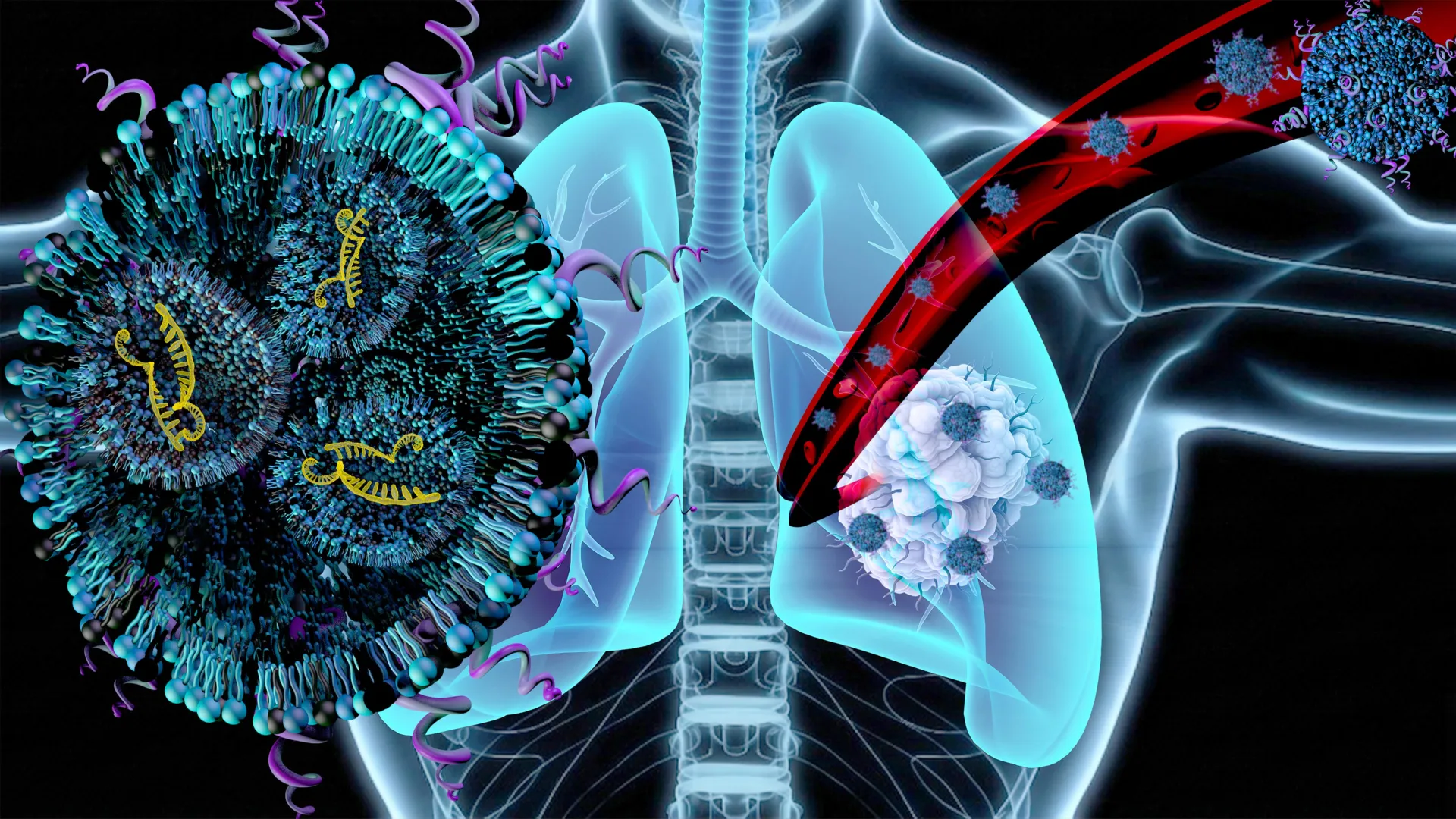
Researchers at Oregon State University have developed an experimental treatment designed to tackle lung cancer and the severe muscle loss that can occur alongside it.
The research, published in the Journal of Controlled Release, uses lipid nanoparticles to carry therapeutic genetic material directly to lung tumors.
In experiments using mice, a team led by Oleh Taratula and Yoon Tae Goo of the OSU College of Pharmacy tested nanocarriers containing follistatin messenger RNA. The nanoparticles accumulated in lung tumors, where the mRNA instructed cells to produce follistatin, a protein that can help suppress tumor growth while also supporting the growth of muscle tissue.
The lipid nanoparticles, known as LNPs, are delivered intravenously. Their ability to reach lung tumors depends in part on vitronectin, a protein naturally found in blood serum.
Lipids are fatty acids and related organic compounds that include many natural oils and waxes. Nanoparticles are extremely small pieces of material, typically measuring between one and 100 billionths of a meter.
"We found that these LNPs bind vitronectin in the bloodstream, which then directs them to lung cancer tumors by interacting with integrin receptors that are overexpressed on the tumor surface," Taratula said.
Integrin receptors help connect cells with their surroundings and influence how cells respond to signals in their environment.
Getting mRNA based therapies to reach lung tumors after being delivered through the bloodstream has been difficult. Conventional lipid nanoparticles often build up in the liver instead of reaching the intended cancer cells.
"Systemic delivery of mRNA therapeutics to lung cancer tumors has been a significant challenge in our field, and this work offers a promising solution," Taratula said. "Compared to conventional LNPs, which tend to accumulate in the liver upon systemic administration, our approach achieved an approximately 2.5-fold greater reduction in tumor burden."
Lung cancer is the third most common cancer in the United States and the leading cause of cancer death (skin cancer is the most common, followed by prostate cancer for men and breast cancer for women).
The American Cancer Society estimates that about 230,000 new cases of lung cancer will be diagnosed in the United States this year and that roughly 125,000 people will die from the disease. Overall, about 5% of people will develop lung cancer, with smokers facing a higher risk.
Lung cancer can also be accompanied by cachexia, a serious condition that causes severe weight and muscle loss. Cachexia can kill as many as 30% of the cancer patients it affects.
Dive deeper
- Researchers at Oregon State University have developed an experimental treatment designed to tackle lung cancer and the severe muscle loss that can occur alongside it.
- The research, published in the Journal of Controlled Release, uses lipid nanoparticles to carry therapeutic genetic material directly to lung tumors.
- In experiments using mice, a team led by Oleh Taratula and Yoon Tae Goo of the OSU College of Pharmacy tested nanocarriers containing follistatin messenger RNA. The nanoparticles accumulated in lung tumors, where the mRNA instructed cells t
- The lipid nanoparticles, known as LNPs, are delivered intravenously. Their ability to reach lung tumors depends in part on vitronectin, a protein naturally found in blood serum.
- Lipids are fatty acids and related organic compounds that include many natural oils and waxes. Nanoparticles are extremely small pieces of material, typically measuring between one and 100 billionths of a meter.