Nobel prize in medicine 2026 awarded for research into mysteries of brain
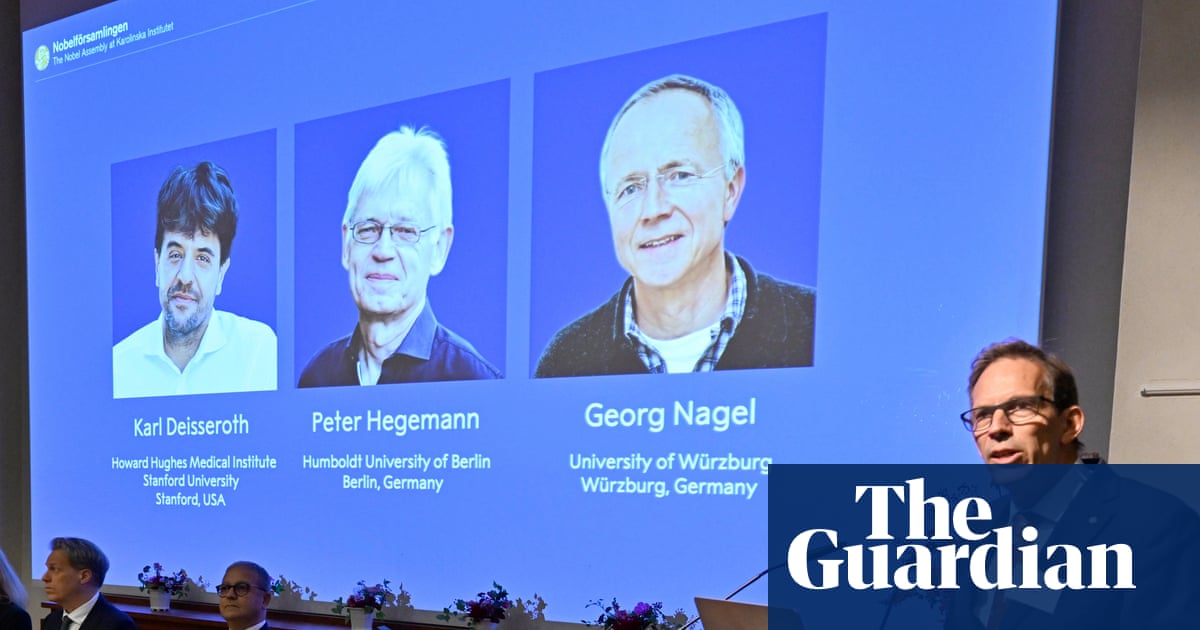
Three scientists to share 12m Swedish kronor prize for their work on ‘light-gated ion channels and optogenetics’
The Nobel prize in physiology or medicine 2026 has been awarded to three scientists for their work investigating the mysteries of the brain.
The Nobel assembly at the Karolinska Institute in Stockholm, Sweden, announced the winners on Monday. They will each receive an equal share of a prize of 12m Swedish kronor (about £900,000).
In a nutshell the trio’s research led to the development of a light-sensitive switch that can be used to control nerve cells in the living brain, switching them on or off.
“Their implications are profound, not only for understanding the human brain, but for opening possibilities into new treatments for neurological and psychiatric disorders,” he said.
Nagel and Hegemann identified the proteins, called channelrhodopsins, and working with frog egg cells they revealed that when the proteins were exposed to blue light, they allowed charged particles – or ions – to flow into the cell, producing an electrical impulse.
Deisseroth took the discovery even further, using rats to demonstrate that by introducing the gene for a channelrhodopsin into nerve cells, it was possible to produce electrical signals in them using light.
He and his colleagues later applied the approach to nerve cells in the motor cortex of the brains of mice, allowing them to use light – delivered by tiny optic fibres passed through their skull – to trigger movement in the rodent’s whiskers.
While rooted in basic science, the team’s work has already had real-world implications, opening up a field of medicine known as optogenetic therapy.
In that case, the genetic instructions for making a channelrhodopsin were delivered by means of a harmless virus into retinal ganglion cells in the man’s eyes.
Prof Botond Roska, the director of the Institute of Molecular and Clinical Ophthalmology Basel who co-led the study, welcomed the announcement of the Nobel laureates.
“This is truly wonderful news. I hope this helps to boost all efforts on optogenetic vision restoration to bring back vision to blind patients,” he said.
Dive deeper
- Three scientists to share 12m Swedish kronor prize for their work on ‘light-gated ion channels and optogenetics’
- The Nobel prize in physiology or medicine 2026 has been awarded to three scientists for their work investigating the mysteries of the brain.
- The Nobel assembly at the Karolinska Institute in Stockholm, Sweden, announced the winners on Monday. They will each receive an equal share of a prize of 12m Swedish kronor (about £900,000).
- In a nutshell the trio’s research led to the development of a light-sensitive switch that can be used to control nerve cells in the living brain, switching them on or off.
- “Their implications are profound, not only for understanding the human brain, but for opening possibilities into new treatments for neurological and psychiatric disorders,” he said.