Scientists just pushed superconductors beyond their usual current limit
Superconductors are among the most remarkable materials in quantum physics. When certain materials are cooled below a specific transition temperature, their electrical resistance disappears. Electricity can then flow through them without losing energy as heat.
This happens because electrons form correlated pairs called Cooper pairs. Instead of moving independently, these pairs act collectively, somewhat like a wave traveling through the material. This unusual property makes superconductors promising for applications including powerful magnets, highly sensitive detectors, and quantum circuits.
But superconductivity cannot withstand unlimited electrical current. Once the current becomes too large, the superconducting state begins to fail. A material's critical current describes the maximum current it can carry before resistance and energy loss appear.
In type-II superconductors, the critical current measured in experiments often does not reflect the true microscopic limit of superconductivity itself. Instead, failure is usually triggered by the movement of vortices, tiny regions where magnetic flux can pass through the material.
As the current rises, these vortices can begin to move. Their motion creates electrical resistance and generates heat, which can ultimately destroy the superconducting state.
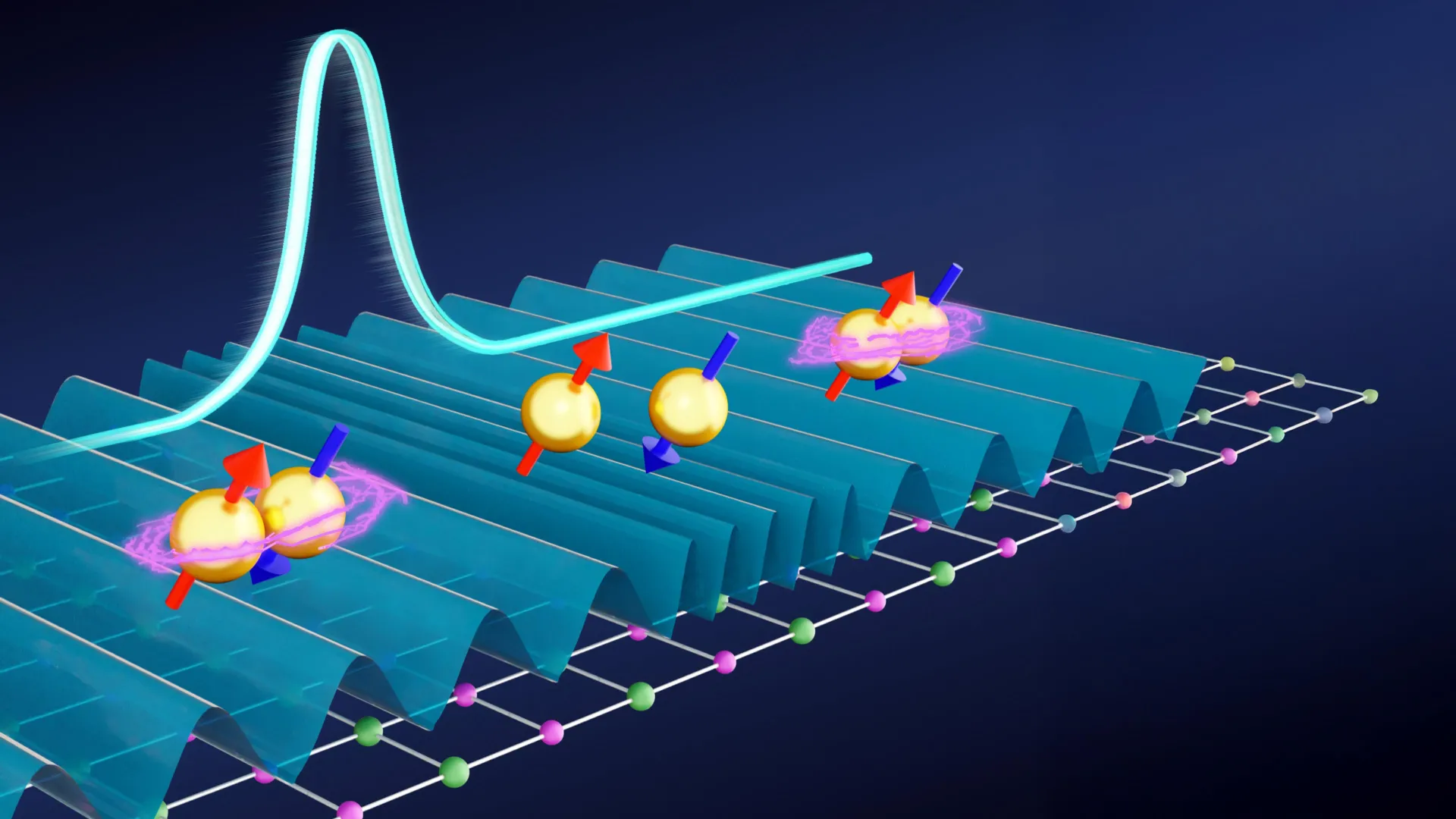
Superconductors actually possess a higher fundamental limit known as the depairing current. "One way to picture it is that the current "twists" the phase of the coherent quantum state of the superconductor, rather like winding a spring," explains Eryin Wang, lead author of the study.
If this quantum state is twisted too far, it becomes unstable. At that point, the Cooper pairs responsible for superconductivity begin to break apart. Conventional direct-current (DC) transport measurements rarely reach this intrinsic limit because moving vortices and heating usually disrupt superconductivity first.
The researchers developed a way to get around that problem by delivering extremely short bursts of electrical current.
Vortices can travel at speeds of tens of kilometers per second, but over the span of a picosecond they move only tens of nanometers. By applying current for an extremely short period, researchers can drive the current density to very high levels before the vortices have enough time to move significantly or heat the material.
This sharply reduces the energy loss caused by vortex motion and allows researchers to push the superconducting state much closer to its fundamental current limit.
To produce these exceptionally short currents, the team used an ultrafast electrical transport platform developed at MPSD.
"To apply current to superconductors for only a few picoseconds, we used the ultrafast electrical-transport platform that we have been developing at our institute," says Guido Meier, co-author of the study.
Dive deeper
- Superconductors are among the most remarkable materials in quantum physics. When certain materials are cooled below a specific transition temperature, their electrical resistance disappears. Electricity can then flow through them without lo
- This happens because electrons form correlated pairs called Cooper pairs. Instead of moving independently, these pairs act collectively, somewhat like a wave traveling through the material. This unusual property makes superconductors promis
- But superconductivity cannot withstand unlimited electrical current. Once the current becomes too large, the superconducting state begins to fail. A material's critical current describes the maximum current it can carry before resistance an
- In type-II superconductors, the critical current measured in experiments often does not reflect the true microscopic limit of superconductivity itself. Instead, failure is usually triggered by the movement of vortices, tiny regions where ma
- As the current rises, these vortices can begin to move. Their motion creates electrical resistance and generates heat, which can ultimately destroy the superconducting state.