

How a Tiny, Soft Robot Glows Green When It Stretches Its Limbs
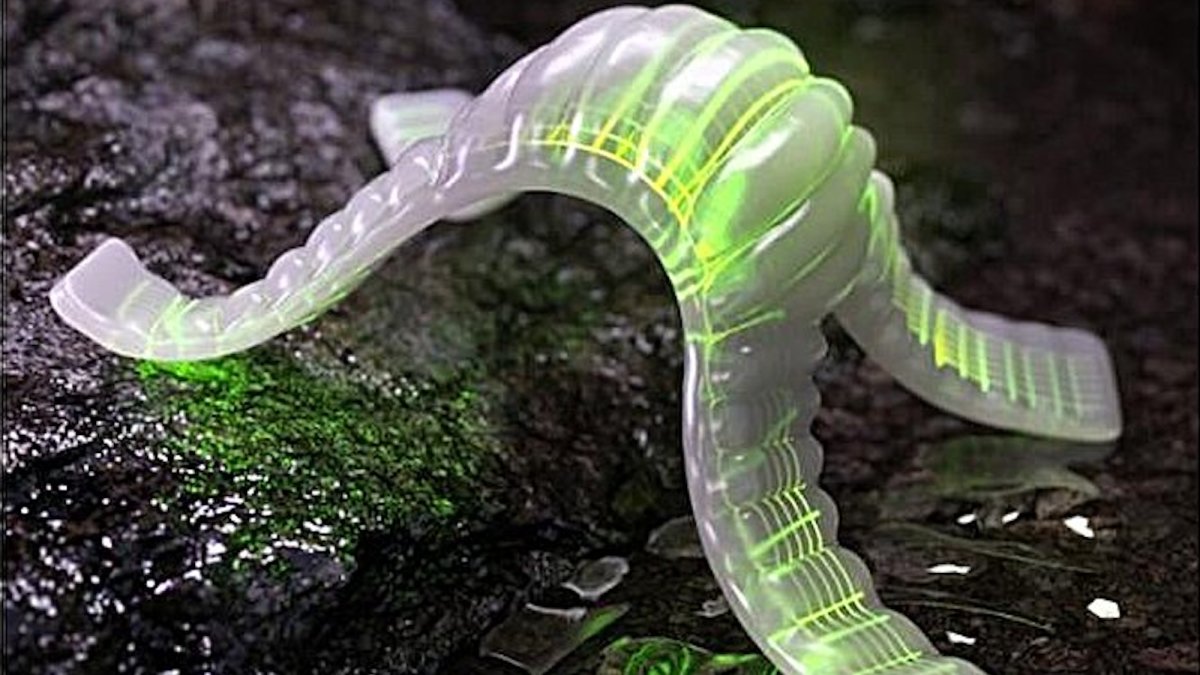
Light reveals where strain occurs
The robot, developed by a team at South Korea’s Daegu Gyeongbuk Institute of Science and Technology, resembles a mix of an octopus and an earthworm. Its four limbs move across difficult terrain, while the material inside them emits light as it stretches.
The effect is called mechanoluminescence. Zinc sulfide particles in flexible polymers glow green in areas experiencing stress, giving a visible indication of deformation without added electronics or batteries.

A resilient woven structure
The team made a thin, durable tubular fiber from zinc sulfide particles and flexible polymers. They filled elastic silicone tubes with the material, then wove the tubes into a mesh-like casing for a pneumatic soft robot.
Laboratory tests showed the fibers could stretch to more than twice their original length. They also kept glowing after over 1,000 cycles, according to the study published in Small Structures.
Potential uses beyond robotics
Study co-author and DGIST engineer Soon Moon Jeong said the approach could help researchers locate and analyze deformations in soft robots. Because it needs no extra components that might limit movement, he sees it as a promising alternative to existing options.
The team is working to improve the fibers’ brightness and resilience. The researchers say the technology could eventually be used in wearable medical devices or artificial skins.
Key points
- The robot’s limbs glow green where the material experiences stress.
- Its mechanoluminescent fibers need no external batteries or electronics.
- Testing found the fibers still glowed after more than 1,000 cycles.
- Potential applications include wearable medical devices and artificial skins.