

How a robo frog swims using liquid crystal muscles powered by light
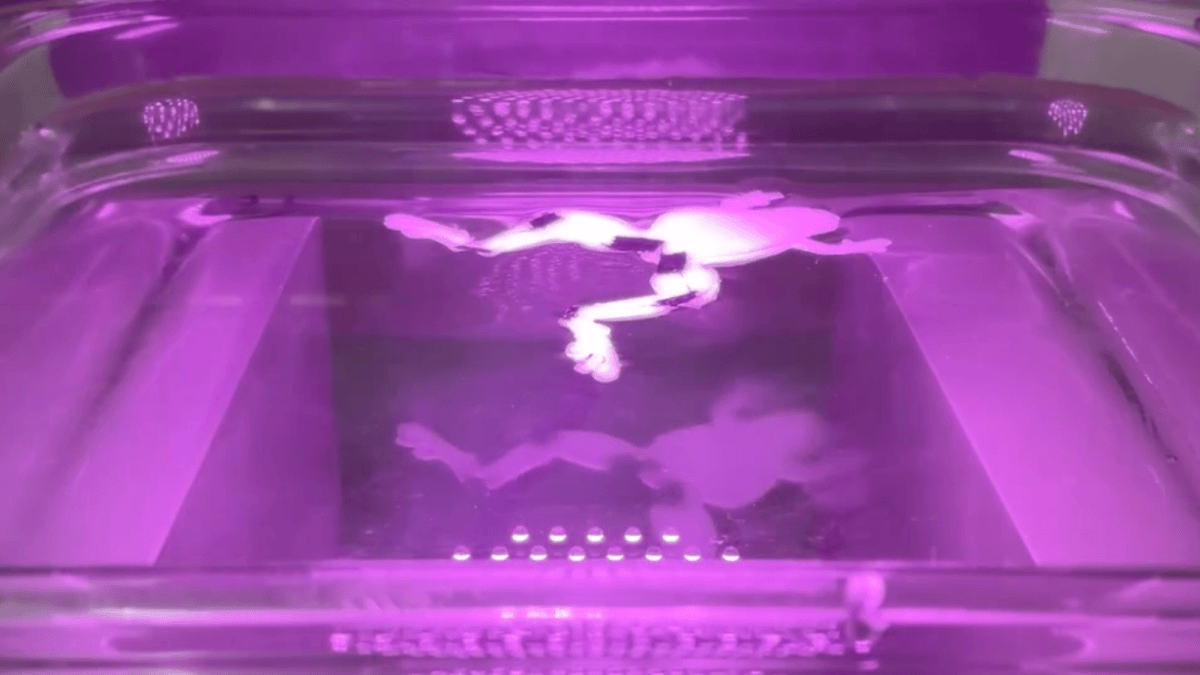
Light activates the muscles
The robot’s six artificial muscles are made from crystal elastomers. They contract as they heat and return to their original shape as they cool. The team added a molecule that turns near-infrared light into heat. When a lamp shines on the muscles, they tighten and help propel the silicone frog through water.
The system is described in a study published in Advanced Materials Technologies. The robot moves without any moving parts, though its swimming is slow compared with that of a real frog.
Coordination proved difficult
Making all six muscles work together was a major challenge, said study co-author Brigitte Städler, an Aarhus University chemist. If the muscles contract out of sync, the frog may spin rather than swim forward.
The researchers also had to refine the elastomer so it would contract properly and could be used in a 3D printer. Ryberg tested different molecular ingredients and chain lengths to find a suitable mixture. Ryberg compared the material to thick syrup or icing, which can be squeezed through a piping bag, rather than the solid plastic filament commonly melted in a conventional 3D printer.
A slow proof of concept
At its fastest, the frog traveled a little over three inches in about two minutes. The pace is modest, but the demonstration offers another approach to designing and powering soft robots.
The researchers suggest the system could eventually support robots used in search and rescue or environmental monitoring. Ryberg said she could imagine the robots being toys before they are used on rescue missions.
Key points
- Six near-infrared light-activated muscles move the silicone frog through water.
- The muscles use crystal elastomers that contract when heated and recover as they cool.
- Researchers see possible future uses in rescue or environmental monitoring, while toys may come first.