

How a Massive Simulation Reveals the Universe Emerged from Darkness
The universe before starlight
After the Big Bang, the universe expanded and cooled from a hot, dense state. Around 380,000 years later, electrons joined atomic nuclei to form neutral hydrogen, and the cosmos entered the period known as the cosmic dark age.
Stars had not yet formed to light the universe. Neutral hydrogen filled space and absorbed some radiation, including ultraviolet light that would later come from the first stars.
A simulation across cosmic history
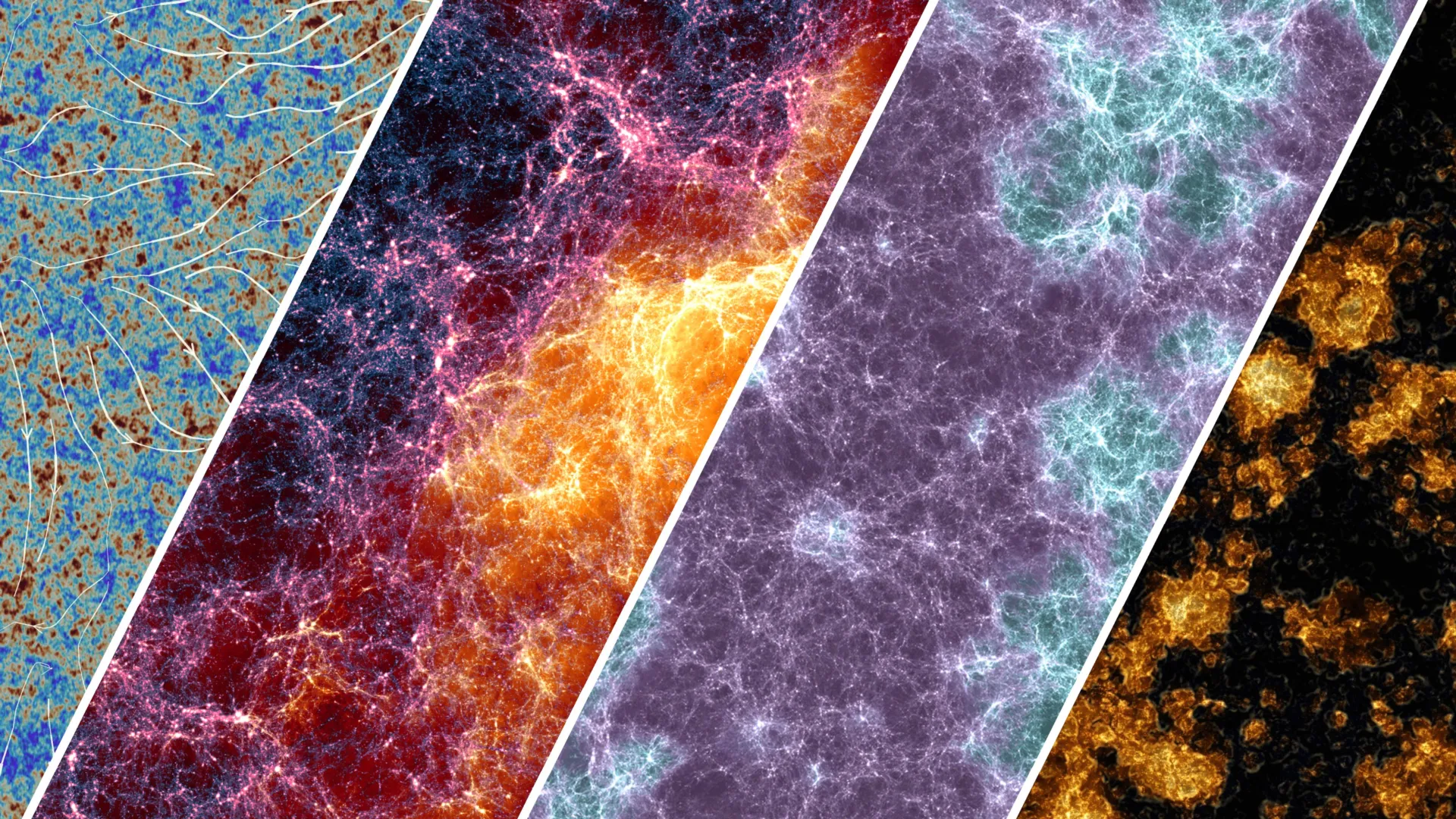
Lumina follows 2 billion years of cosmic history across a volume 500 megaparsecs wide, or about 1.6 billion light-years. It models dark matter, gas, stars and radiation, capturing large-scale matter and the formation of individual galaxies.
Two changes to the early cosmos
As the first stars and galaxies produced ultraviolet radiation, it stripped electrons from neutral hydrogen. This hydrogen re-ionization made the universe increasingly transparent to ultraviolet light, allowing it to travel farther and helping clear the gas that had filled space.
Helium re-ionization required more energetic radiation. The results indicate that early stars and galaxies were chiefly responsible for hydrogen re-ionization, while actively feeding supermassive black holes supplied the energy needed to ionize helium.
A resource for other researchers
Lumina is the first simulation to capture hydrogen and helium re-ionization together. Study author Mark Vogelsberger, an MIT physics professor, said it covers small-scale star and galaxy formation through large-scale re-ionization in a volume 100 times larger than previous best simulations.
The researchers are making the simulation available to other scientists. Its predictions can be compared with observations from existing and future telescopes to help investigate the formation of the first stars and galaxies. Lumina takes its name from a Latin word meaning “lights.”
Key points
- Lumina models 2 billion years across a region about 1.6 billion light-years wide.
- The simulation captures hydrogen and helium re-ionization together for the first time.
- Early stars and galaxies drove hydrogen re-ionization; actively feeding supermassive black holes supplied radiation for helium re-ionization.
- Researchers are sharing Lumina so its predictions can be compared with telescope observations.