Phoebe Giannisi’s poetry challenges the idea that humans are separate from nature
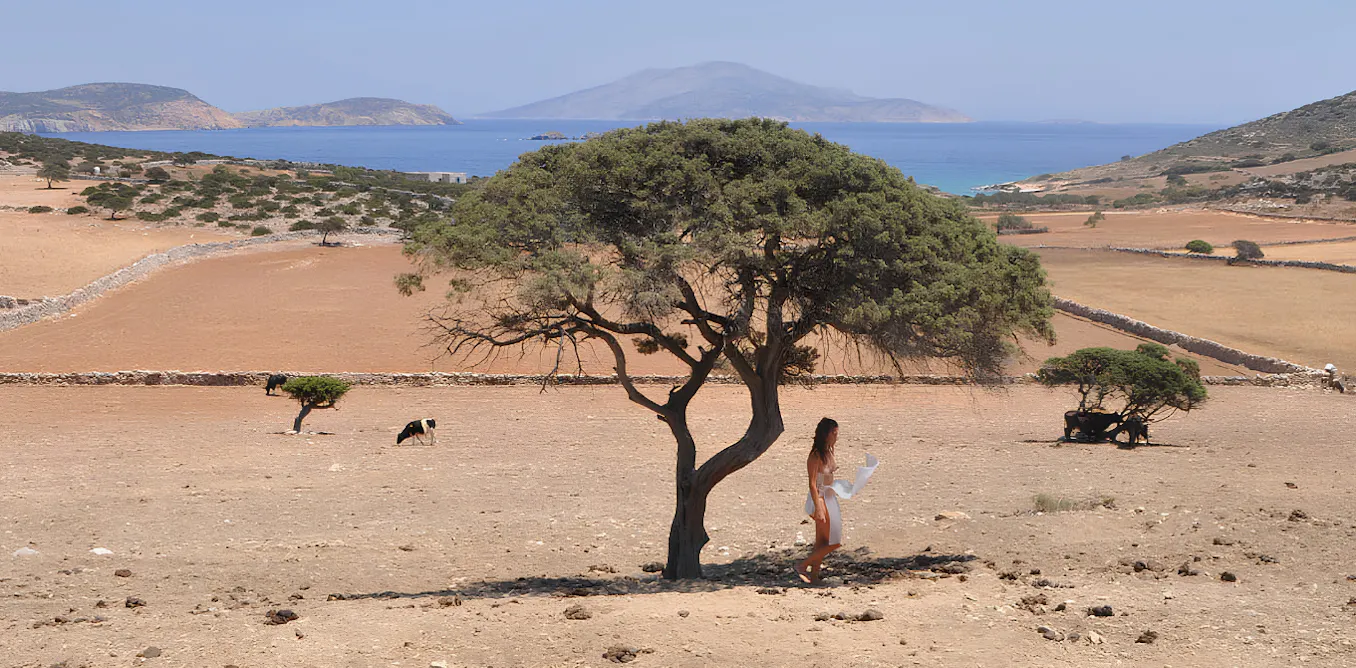
Myth and biological entanglement
Giannisi’s work spans poetry, classical studies, performance, architecture and environmentalism. It combines ancient Greek myth with site-specific performance, video poems and field recordings. In Chimera, published in 2024, she links Homer’s legendary chimera to microchimerism, the presence of one organism’s cells inside another. The collection presents people as collaborative beings rather than separate masters or rescuers of nature.
Her poems suggest that damage to a landscape also harms the many forms of life with which humans are intertwined. The chimera becomes an image of that shared existence.
More than a human voice
Giannisi’s collection Goatsong, published in 2025, brings human and non-human voices into the same poetic space. Cicada, her 2022 collection, centers on the insect and draws on texts by Plato, Archilochus and the Japanese poet Bashō.
Observations of the cicada’s life cycle and mating calls sit alongside those older writings. The insect’s song serves as testimony from the natural world, asking readers to attend to a voice beyond the human one.
A record of shared survival
In Chimera, Giannisi follows traditions of Vlach herding communities in northern Greece, whose livestock travel between mountain and valley pastures with the seasons. Her approach avoids idealizing pastoral life.
She brings together state archives, regional oral histories and field recordings. In performances, shepherds’ calls meet herd sounds, a passing motorcycle and a cement mixer, placing animal and industrial landscapes side by side.
The layered sound asks listeners to experience both worlds at once. It also conveys the beauty of shared life and the vulnerability of the environment.
Poetry made physical
Trained as an architect, Giannisi treats language as something people can move through and sense. In 2017, for Aigis II at the Panourgias Museum in Amfissa, Greece, she wrote poetry on semitransparent goatskin parchment, tracing migration routes on one side and writing verse on the other.
Her performances also use the body as a way to hold environmental memory. At times, she blocks her own sight with a cloth or basket, shifting attention away from the human gaze. Her poems evoke earthy taste, sea salt and animal smells.
Giannisi is due to appear at the University of Bristol in late autumn with poet-translator Brian Sneeden. The event will bring her work into a new architectural space.
Key points
- Chimera connects ancient Greek myth with microchimerism, in which cells from one organism can persist inside another.
- Giannisi’s poetry gives insects and other non-human life a place alongside human voices.
- Her work documents seasonal herding traditions and sets animal sounds against modern industrial noise.
- Installations and performances make landscape, language and the human body part of environmental memory.