Nobel Prize for economics awarded to Hall and Woodford for work on ‘smoothing’ crises
US economists developed models that help central bankers and finance ministers to stabilise their economies
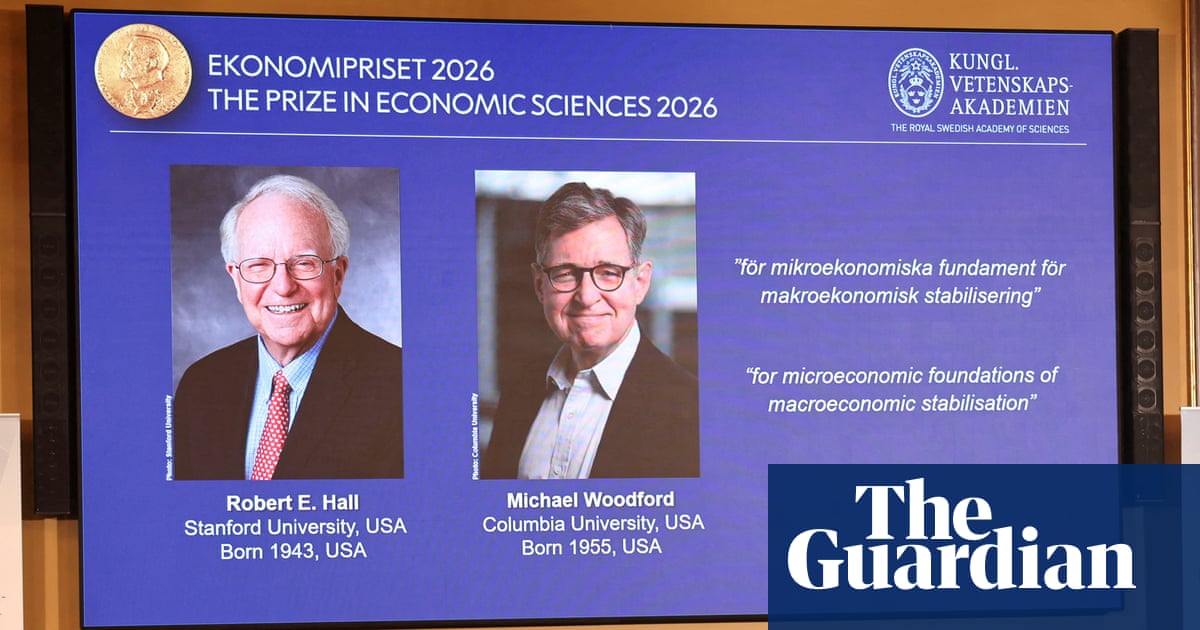
Two US economists have won the 2026 Nobel economics prize for their work developing models that help central bankers and finance ministers to stabilise their countries, avoiding long recessions and runaway inflation.
The Royal Swedish Academy of Sciences said it was recognising the pair for generating “a paradigm shift in stabilisation policy”, awarding them the prize worth a combined $1.2m (£900,000).
“New Keynesian models, a result of their research, allow us to explain and quantify how stabilisation policy affects business cycles and are now used by central banks and finance ministries around the world,” the academy said.
Hall and Woodford demonstrated how traditional models could be reconstructed, based on how individual households and businesses collectively affect an economy through their actions.
Woodfood built on this work to create the New Keynesian model, a full macroeconomic stabilisation framework that is the main tool for policymakers now.
“The laureates’ work has provided us with a stable theoretical foundation for the models that are now used by central banks and governments around the world. With them, we are better equipped to deal with shocks in the economy, such as energy crises or sudden changes in how much households consume,” John Hassler, the chair of the committee for the economics prize, said.
Forward guidance has had its critics, though – the current chair of the US Federal Reserve, Kevin Warsh, has argued it should only have a “limited and circumscribed” role in normal times, to avoid “creating ambiguity in the name of clarity”.
And in 2014, the then Bank of England governor, Mark Carney, was labelled an “unreliable boyfriend” for dropping hints over interest rate rises that never came to pass.
Hall is also known for coining the idea that US economists can be divided into fresh water and salt water varieties.
Salt water economists, though, cluster at coastal universities, such as Harvard, MIT, UC Berkeley, Yale, Princeton, UCLA and Columbia. They tend to be Keynesians and New Keynesians, believing that governments and central banks can affect demand in their economies.
Dive deeper
- US economists developed models that help central bankers and finance ministers to stabilise their economies
- Two US economists have won the 2026 Nobel economics prize for their work developing models that help central bankers and finance ministers to stabilise their countries, avoiding long recessions and runaway inflation.
- The Royal Swedish Academy of Sciences said it was recognising the pair for generating “a paradigm shift in stabilisation policy”, awarding them the prize worth a combined $1.2m (£900,000).
- “New Keynesian models, a result of their research, allow us to explain and quantify how stabilisation policy affects business cycles and are now used by central banks and finance ministries around the world,” the academy said.
- Hall and Woodford demonstrated how traditional models could be reconstructed, based on how individual households and businesses collectively affect an economy through their actions.