
Who Is Anne Carson, the Nobel Prize–Winning Canadian Writer?
Carson’s poetry, essays and translations bring ancient Greek literature into conversation with modern life.
The short version
- Anne Carson is a Canadian poet, essayist and translator who received the 2026 Nobel Prize in Literature. 134
- The Swedish Academy praised the way her writing engages with classical literature while making new forms for contemporary writing. 13
- Her work moves among poetry, prose, translation and literary criticism, often drawing on ancient Greek literature and mythology. 34
- Autobiography of Red retells a Greek myth as a modern story, while Eros the Bittersweet explores desire through literary criticism and classical texts. 14
Who is Anne Carson?
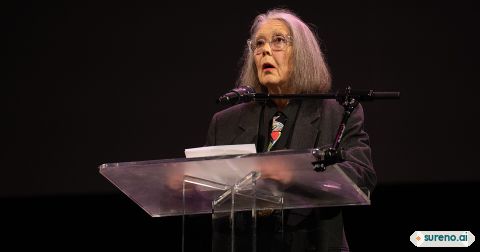
Anne Carson is a Canadian poet, essayist and translator. The Swedish Academy awarded her the 2026 Nobel Prize in Literature, announced on October 8. The prize recognises a body of work rather than a single book. 134
Carson was born in Toronto in 1950. She has taught classics, creative writing and comparative literature at universities including McGill and Princeton, and has worked as a professor of classics for more than 30 years. 13
Why did Anne Carson win the Nobel Prize?
The Swedish Academy cited Carson’s body of work for its inventive approach and its engagement with the classical tradition. In plain terms, her writing does not simply repeat ancient stories or ideas. It brings them into contact with modern subjects and experiments with how literature can be shaped. 134
That combination helps explain why accounts of her work describe it as crossing boundaries between poetry, prose, fiction, scholarship and translation. The sources do not suggest that one particular book alone earned the award. 34
What makes Anne Carson’s writing distinctive?
Carson’s writing often puts ancient Greek material beside contemporary experience. Her work draws on Greek literature and mythology, but also reflects other influences, including the King James Bible and modern writers such as Emily Dickinson and Virginia Woolf. 14
She also shifts between forms. A reader may encounter poetry alongside prose, translation or literary analysis. That means her books can ask readers to follow an idea across different kinds of writing rather than stay within one familiar category. 34
Carson studied classics, the academic field concerned with ancient Greek and Roman languages and literature. Her work makes that material part of a creative conversation, rather than treating it only as distant history. 13
Which Anne Carson books should readers know?
Eros the Bittersweet, published in 1986, was Carson’s first book of criticism. It combines literary analysis with an examination of desire and ancient Greek writing. Its reception and influence have extended beyond classicists to poets and other writers, according to DW. 14
Autobiography of Red, published in 1998, is among her best-known works. The Guardian describes it as a novel in verse inspired by fragments of the ancient Greek poet Stesichorus. It recasts the myth of Geryon as a modern story about a teenage boy facing heartbreak and desire. 4
The Beauty of the Husband, a poetry collection published in 2001, received the T. S. Eliot Prize. The Guardian reports that Carson was the first woman to win that prize. 14
How does Carson connect ancient and modern literature?
One way is through adaptation: she takes material from ancient texts and gives it a new setting or form. Autobiography of Red is a clear example, transforming a Greek myth into a story set in a recognisably modern emotional world. 4
Another way is translation. Carson has translated ancient Greek poets and playwrights, including Sappho and Sophocles. Translation means rendering a work from one language into another; it also involves choices about how its meaning and style should reach new readers. 14
The available sources describe these broad features, but they do not provide enough detail to explain Carson’s methods across every book. Readers can explore the books themselves or consult reliable literary coverage for closer discussion.
What does the Nobel Prize mean for readers?
The award brings wider attention to Carson’s writing and to work that crosses usual divisions between poetry, essays, fiction and scholarship. For readers who want a starting point, the sources identify Eros the Bittersweet, Autobiography of Red and The Beauty of the Husband as notable works. 14
The sources available here report the award and describe Carson’s career, but offer only a limited account of what readers may find challenging or rewarding in each book. The best choice depends on whether a reader is drawn to poetry, myth, literary criticism or translation.
What we don't know yet
- The available reports do not give further detail about Carson’s plans following the award.
- The sources offer only a brief account of how readers and literary scholars may interpret the full range of her work.
- The supplied reports do not provide a complete, verified bibliography of Carson’s books and translations.
Share this explainer
Get this every day, on every new tab
Sureno Browser brings the day's stories, explained simply, to your start page.
Questions people ask
Did Anne Carson win the 2026 Nobel Prize in Literature?
What is Anne Carson best known for?
What is Autobiography of Red about?
It is a novel in verse inspired by fragments of the ancient Greek poet Stesichorus. The Guardian describes it as a modern retelling of the myth of Geryon, centred on a teenage boy navigating heartbreak and desire. 4
What is Eros the Bittersweet?
Sources
- Nobel Prize in Literature goes to Canada's Anne Carson — dw.com, 2026-10-08
- Canadian poet Anne Carson wins Nobel Prize in Literature — BBC News
- Anne Carson wins Nobel prize in literature 2026 — the Guardian, 2026-10-08
Free tools for this
They run in your browser. Nothing is uploaded and there is nothing to sign up for.
More to read
 TV, Film & CultureWhy Nikon Disqualified Its Small World Video WinnerOct 10, 2026 · 3 min read0 views
 TV, Film & CultureGTA VI Radio Stations: Hosts and Music Announced So FarOct 9, 2026 · 3 min read0 views
 TV, Film & CultureAnne Carson’s Writing: Poetry, Myth and Modern FormsOct 8, 2026 · 3 min read0 views
 TV, Film & CultureAnne Carson Wins the 2026 Nobel Prize in LiteratureOct 8, 2026 · 3 min read0 views
 Tech & Online SafetyInductive Charging: How Wireless Power Works at HomeOct 3, 2026 · 3 min read1 view
 TV, Film & CultureTwin Atlantic Cancels UK Tour: What Ticket Holders Should KnowOct 7, 2026 · 3 min read0 views
 TV, Film & CultureWho Is Murray Hill? The Performer Behind Showbiz!Oct 7, 2026 · 3 min read0 views
 TV, Film & CultureWhat to Know About Chicago P.D. Season 14 and Atwater’s ExitOct 7, 2026 · 3 min read0 views
 TV, Film & CultureJimmy McGovern and Time: what to know about series threeOct 7, 2026 · 3 min read0 views
 WorldTropical Storm Nolo Nears Hurricane Strength in the PacificOct 2, 2026 · 2 min read1 view